TEACHER AI COMPETENCY
AI Competency for Teachers
Last updated: October 2026
An independent overview of how The Globals' teacher-controlled approach relates to UNESCO's AI Competency Framework for Teachers — what the product supports today, and where schools carry the wider responsibility.
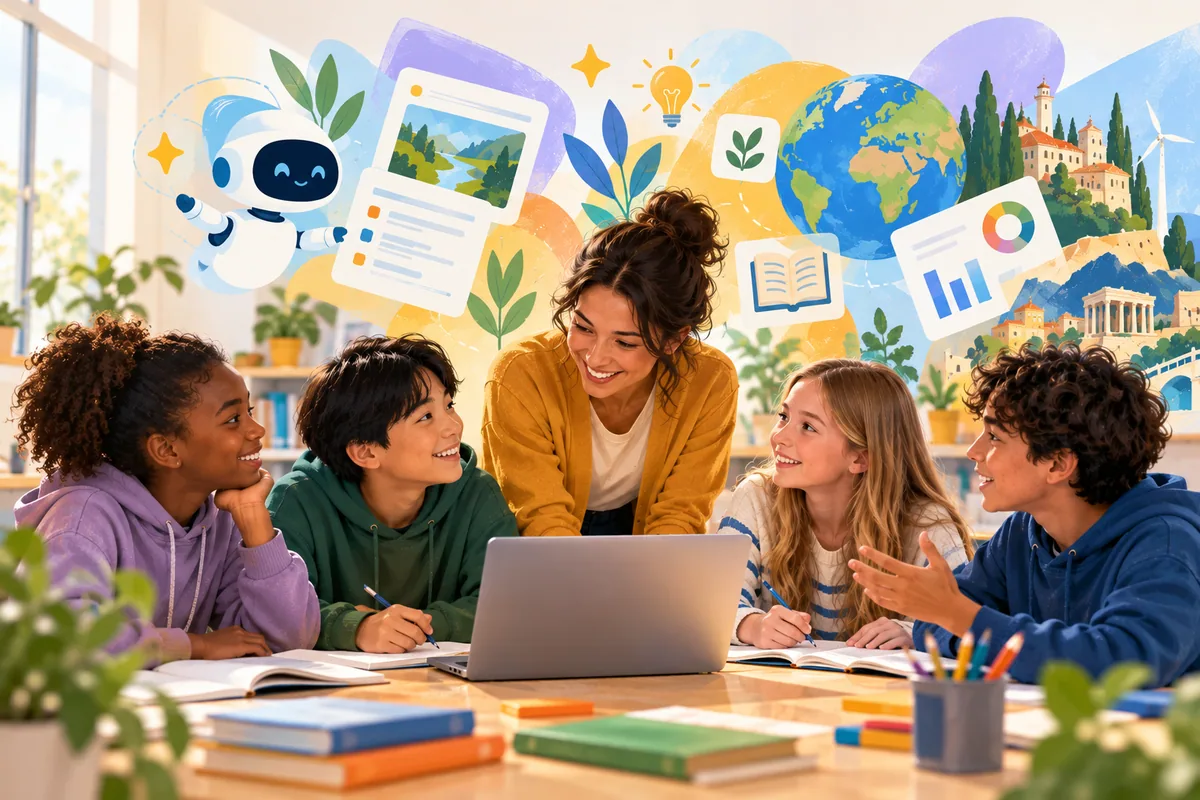
AI should strengthen teaching, not replace teacher judgement.
AI is changing how learning is designed, delivered, and assessed. Teachers need more than access to AI tools: they need the judgement to decide when to use them, the confidence to evaluate their outputs, and the pedagogical understanding to make them serve meaningful learning.
The Globals supports this work through teacher-controlled AI workflows and an educational approach that keeps human judgement, student agency, and meaningful learning at the centre.
Informed by UNESCO's AI Competency Framework for Teachers (2024). This is an independent overview of how The Globals' current approach relates to the framework. It does not represent UNESCO certification, endorsement, or a claim of complete framework coverage.
WHY TEACHER AI COMPETENCY MATTERS
AI changes the tools. Teachers remain central to learning.
AI can support preparation, content creation, analysis, and feedback. But effective educational use requires teachers to make informed decisions, check outputs, protect learners, consider inclusion, and choose appropriate pedagogical strategies.
Professional judgement
AI can assist with tasks, but teachers determine what is educationally appropriate.
Responsible practice
Educational AI use requires attention to privacy, safety, fairness, inclusion, and accountability.
Meaningful pedagogy
AI should strengthen thinking, participation, creativity, and learning rather than simply automate activities.
THE FRAMEWORK
Five dimensions of teacher AI competency
UNESCO's 2024 framework describes 15 competency blocks across five dimensions, structured around three progression levels.
DIMENSION 1 OF 5
Human-centred mindset
Keeping human agency, human needs, and human responsibility central to interactions with AI.
DIMENSION 2 OF 5
Ethics of AI
Understanding and applying ethical principles for safe, responsible, inclusive, and accountable AI use.
DIMENSION 3 OF 5
AI foundations and applications
Understanding AI at an appropriate level and evaluating, selecting, and applying tools for relevant tasks.
DIMENSION 4 OF 5
AI pedagogy
Integrating AI purposefully into lesson preparation, teaching, learning activities, and assessment.
DIMENSION 5 OF 5
AI for professional development
Using AI and professional reflection to support continuing learning and collaborative development.

Read the UNESCO framework
The original 2024 publication with all 15 competency blocks and progression levels.
unesco.orgPROGRESSION
From understanding AI to shaping its use
Three developmental levels. UNESCO describes progression as contextual and not strictly linear — a reference for growth, not a certification scheme.
LEVEL 1
Acquire
Build the foundations
Develop essential AI literacy, recognise benefits and risks, understand ethical principles, and evaluate and use appropriate AI tools.
LEVEL 2
Deepen
Integrate with purpose
Apply AI more confidently in teaching and learning while maintaining human accountability, safe and responsible practice, and appropriate pedagogical judgement.
LEVEL 3
Create
Shape new possibilities responsibly
Explore advanced, innovative, and context-specific educational uses of AI, contribute to ethical practices, and support wider professional transformation.
Not every teacher needs to reach the Create level, and using The Globals does not automatically advance a teacher through these levels. Schools decide what progression looks like in their own context.
PRODUCT MAPPING
Where The Globals supports teacher AI competency
A framework becomes useful when its principles inform everyday educational practice. The Globals provides teacher-controlled tools for designing and delivering meaningful learning. The following mapping distinguishes current product support from areas that require broader school policies, additional professional learning, or dedicated capabilities beyond The Globals.
Human-centred mindset
Teachers preserve human agency and remain responsible for pedagogical decisions.
Teacher AI Studio supports teacher-controlled preparation and delivery through Generate → Refine → Save → Assign. Teachers review and adapt AI-generated materials before classroom use. The product philosophy places teacher judgement and student thinking above automation.
Ethics of AI
Teachers need to consider responsible use, privacy, fairness, safety, and the implications of AI use in education.
Class-level AI-use policies let teachers set expectations per class. Students complete AI-use declarations — with reflection when Writing Coach was used — before submission, and the AI Literacy Report gives teachers class-level visibility for oversight. These workflows support responsible practice but do not replace institutional governance, legal review, privacy assessments, or a school's own responsible-AI policies.
AI foundations and applications
Teachers need to understand AI sufficiently to evaluate its capabilities, limitations, and appropriateness for educational tasks.
Teacher AI Studio enables practical use of AI for classroom material creation and refinement. Providing AI tools is not the same as teaching how AI models work, assessing bias technically, or delivering a complete AI foundations course — foundational training is not a dedicated offering.
AI pedagogy
Teachers select and integrate appropriate AI tools into pedagogical strategies, learning activities, and assessment.
Teacher AI Studio supports generation, refinement, saving, and assignment of classroom-ready reading, quiz, writing, discussion, and project materials. Teachers adapt materials to their classes, learning goals, levels, and global themes.
AI for professional development
Teachers continue developing their competencies, reflect on practice, and participate in professional learning and collaboration.
Teachers can review learner work — including AI-use declarations, reflection notes, and the class-level AI Literacy Report for writing assignments — and use that evidence to reflect on their teaching practice. This is indirect support for reflective practice, not a structured certification programme, UNESCO competency assessment, accredited professional development, or professional-learning community.
CLASSROOM PRACTICE
A practical way to work with AI
A practical illustration of teacher-led AI use — not an official UNESCO-prescribed process. AI assists; the teacher determines what is appropriate.
Define the learning goal.
Decide what students should understand, express, or accomplish.
Choose AI purposefully.
Determine whether AI genuinely supports that learning objective.
Generate and review.
Use Teacher AI Studio where appropriate, then check facts, suitability, bias, language level, and context.
Refine with professional judgement.
Adapt the material to the class, curriculum, and individual learning needs.
Set clear expectations.
Explain the permitted use of AI and the work students are expected to do themselves.
Reflect and improve.
Review student work, participation, and feedback to decide what should change in the next lesson.
Teacher AI Studio follows a Generate → Refine → Save → Assign flow: nothing reaches students without teacher review.
FOR SCHOOLS
Responsible AI is a school practice, not a software switch.
Successful implementation also depends on school policy, appropriate tool selection, privacy and safety controls, teacher preparation, inclusion, and continuing review.
- Establish clear institutional expectations for AI use.
- Give teachers the time and guidance to evaluate tools and develop their practice.
- Evaluate whether AI improves learning outcomes and preserves student agency, rather than measuring success solely by technology adoption.
Buying The Globals — or any AI product — does not by itself fulfil these responsibilities.
SOURCE AND ATTRIBUTION
Reference
Miao, F., & Cukurova, M. (2024). AI competency framework for teachers. UNESCO.
- Publication PDF:
- UNESDOC record pf0000391104
The framework is available under the Creative Commons Attribution-ShareAlike 3.0 IGO licence (CC BY-SA 3.0 IGO).
Read the original frameworkWhat this page does not claim
The Globals is an independent organisation and is not affiliated with, endorsed by, sponsored by, or acting on behalf of UNESCO. The UNESCO name and logo are used here solely to identify the source framework. The Globals' discussion of UNESCO's AI Competency Framework for Teachers is an independent, product-specific overview of areas of relevance and support. It does not imply endorsement, certification, or formal assessment by UNESCO. The Globals does not claim to cover every competency in the framework.
We are not affiliated with UNESCO. The UNESCO name and logo belong to UNESCO and are shown here only to identify the source publication linked on this page.
Bring thoughtful AI integration into your classrooms.
Explore how The Globals helps teachers create meaningful learning experiences, guide responsible AI use, and keep professional judgement at the centre. Also see how students build judgement about AI through student AI literacy.