FRAMEWORK ALIGNMENT
AI Literacy Alignment
Last updated: June 2026
A practical overview for schools evaluating how The Globals supports responsible AI literacy — embedded in English learning, delivered through teacher-controlled tools.
WHY THIS PAGE
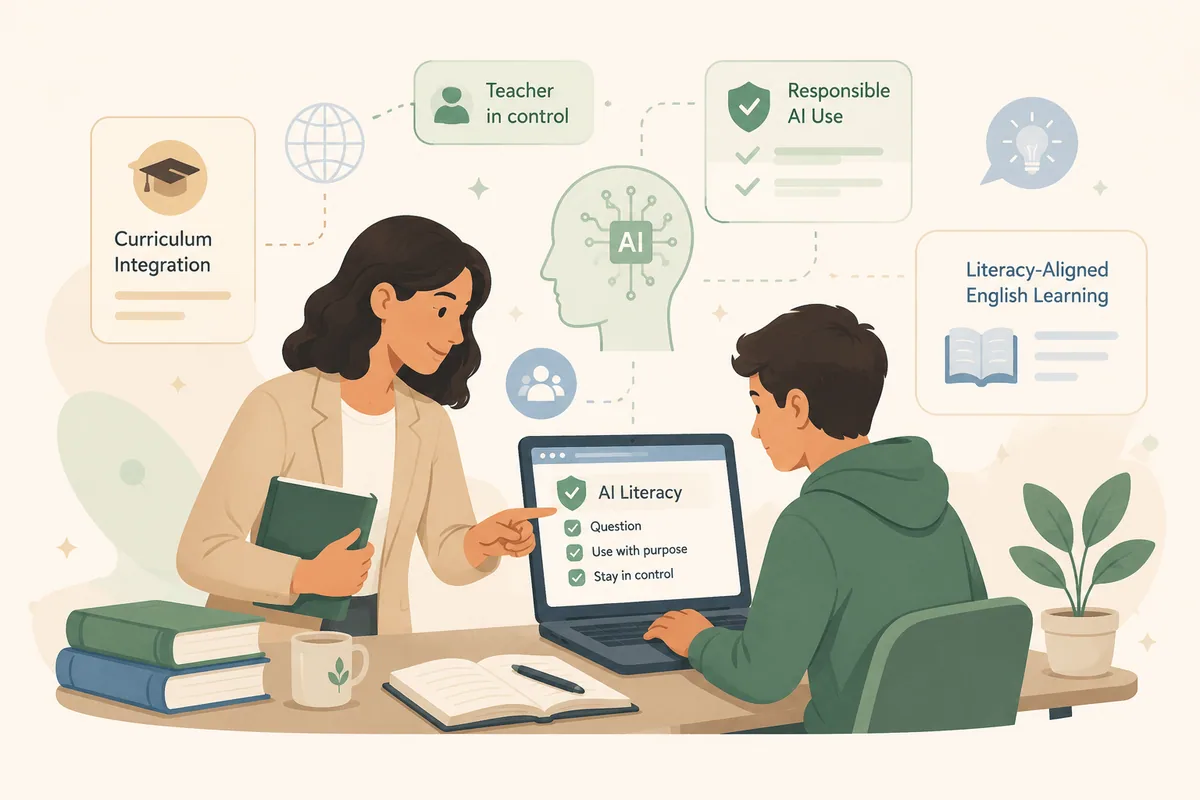
Schools need literacy, not just access
Young people already use AI — education must help them question it, use it with purpose, and stay in control of their learning.
The Globals embeds AI literacy inside a modern English curriculum while giving teachers an implementation layer to design and deliver literacy-aligned learning — without a separate AI vendor or bolt-on course.
THE FRAMEWORK
About the EC/OECD AILit Framework
Empowering Learners for the Age of AI
Defines AI literacy as the knowledge, skills, and attitudes learners need to engage, create with, manage, and shape AI — while critically evaluating benefits, risks, and ethics.
ailiteracyframework.org
AILit Framework (OECD / European Union, 2026, CC BY 4.0). References describe alignment intent, not official endorsement. CC BY 4.0.
OUR APPROACH
Two layers, one platform
Embedded student literacy plus teacher infrastructure — aligned with how the framework expects schools to implement AI literacy.
Embedded literacy
Students develop AI literacy inside meaningful English and global citizenship learning — through writing, discussion, and inquiry — rather than as a separate AI course.
Teacher infrastructure
Teacher AI Studio turns framework goals into classroom-ready materials: generate, refine, save, and assign — with teachers in control at every step.
ALIGNMENT OVERVIEW
Four AILit domains
The framework presents domains sequentially. Below is an honest summary of how The Globals supports each today.
Engage with AI
EngageRecognise AI, evaluate outputs, and consider its role in daily life.
Global themes (Technology & Society, Media & Critical Thinking, Ethics & Leadership), discussion-based learning, and critical thinking activities give students contexts to question AI outputs and explore ethical use.
Create with AI
CreateUse AI as a creative partner while maintaining human agency.
Student Writing Coach supports Draft → Review → Revise → Submit cycles with structured feedback. Students iterate on their own ideas and decide which AI suggestions to accept, adapt, or reject.
Manage AI
ManageTeachers set the rules; students declare how they used AI.
Teachers assign AI-supported, human-only, or AI-assisted policies per class. Students complete AI use declarations — and reflection when they used Writing Coach — before submit. The AI Literacy Report gives class-level evidence for oversight, without a separate AI skills curriculum.
Shape AI
ShapeConsider how AI is steered by society, ethics, and human values.
The Globals does not offer a dedicated Shape AI or “how to use AI” course. Students encounter values, ethics, and societal questions through global themes and moderated discussion — aligned with Shape ideas at an age-appropriate level, not as standalone AI systems training.
PRODUCT MAPPING
Where it lives in The Globals
Features that translate framework domains into daily classroom practice.
Teacher AI Studio
Create · Manage
Generate, refine, save, and assign reading, quiz, writing, discussion, and project materials.
Student Writing Coach
Create
Guided draft and revision flow with actionable AI feedback before final submission.
Global themes & SDG units
Engage · Shape
Inquiry-based English through technology, media, ethics, sustainability, and culture — including societal and values-focused discussion, not a standalone AI course.
Discussions & Write & Act
Engage · Create
Structured prompts for debate, reflection, and student voice — with teacher moderation.
AI Literacy Report
Manage
Class-level visibility into AI writing submissions: student declarations, reflection, review depth, and export for leadership review.
AILit Framework (OECD / European Union, 2026, CC BY 4.0). References describe alignment intent, not official endorsement. Framework reference.
What we do not claim
- No official endorsement by the OECD, European Commission, or any government body.
- Not full coverage of every AILit competence at every progression level.
- Not a standalone AI literacy course separate from English and global learning.
- No dedicated “how to use AI” lessons or Shape AI technical curriculum — alignment is through embedded English learning, teacher control, and classroom evidence.
- Using AI tools alone does not develop literacy — guided inquiry, reflection, and teacher scaffolding are essential.
The Globals supports alignment with internationally recognised approaches to AI literacy in education. References to the AILit Framework describe alignment intent and do not constitute official endorsement by the OECD or the European Union.
For teachers: AI competency
Student literacy is one dimension. See how The Globals supports teacher-led AI integration, informed by UNESCO's AI Competency Framework for Teachers (2024).
See it in your context
Explore the home page AI section or contact us to walk through Teacher AI Studio and student learning flows with your team.